Feral and Festive Raccoon Embroidery
A Practical Review for Small Business Merchandise & Branded Patches
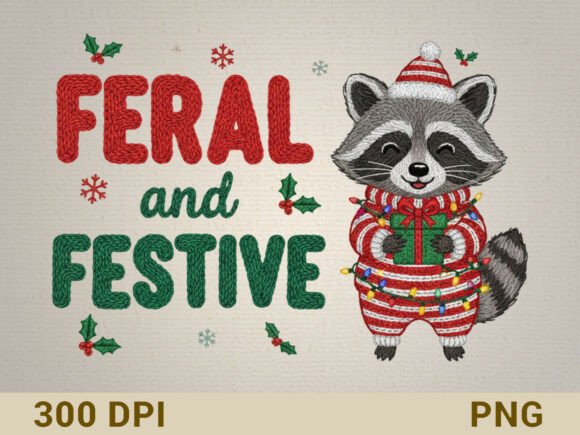
As an embroidery designer who’s digitized over 2,000 logos for cafés, boutiques, bakeries, pet brands, and handmade studios, I approach every new design with two questions: “Will it stitch cleanly on real fabric?” and “Does it strengthen brand identity—not just decorate it?” That’s why Feral and Festive Raccoon Embroidery caught my attention. The title alone hints at personality—playful but grounded, whimsical yet intentional. For a small business owner choosing a chest logo for staff aprons or a patch for tote bags sold at a local farmers’ market, that duality matters. It’s not just cute; it’s memorable, ownable, and commercially versatile.
First Impression: Friendly, Handmade, and Distinctly Local
Based on the title and product category (T-Shirt Designs, Graphics), Feral and Festive Raccoon Embroidery signals a warm, approachable aesthetic—think rustic charm meets modern illustration. It leans into the handmade product ethos without sacrificing polish. That balance is gold for small businesses trying to stand out in saturated markets: a florist using it on canvas totes, a pet-friendly café embroidering it on barista aprons, or an Etsy seller stitching it onto limited-run denim jackets. It doesn’t scream “corporate.” It whispers “we’re thoughtful, we’re local, and we’ve got character.” That builds instant customer trust—especially when paired with consistent application across uniforms, packaging, and digital mockups.
Real-World Performance Across Merchandise Types
Feral and Festive Raccoon Embroidery shines where personality meets practicality:
- Embroidered patches: Its likely silhouette-based composition (inferred from the high-res PNG with transparent background) translates beautifully to twill or chenille backing—ideal for sew-on or iron-on applications on jackets, backpacks, or shop signage.
- Staff uniforms & aprons: As a chest accent or sleeve detail, it adds visual interest without overwhelming function. Its festive energy lifts service wear while keeping it professional.
- Cap embroidery: Works best on structured front panels—not curved back closures—provided the design scales well to ~2.25” width. Always test at final size before hooping.
- Tote bag design & product packaging accents: A bold, legible raccoon motif reads clearly at 3–4” wide on natural canvas or cotton duck—perfect for boutique merchandise or branded customer gifts.
- Commercial embroidery projects: Because it arrives as a high-resolution PNG (300 DPI, transparent background), it’s a strong starting point for professional digitizing—but remember: this is not a ready-to-stitch machine embroidery design. You’ll need a digitizer to convert it into a .dst, .pes, or .jef file.
Where to Use It Thoughtfully—Not Just Automatically
Even charming designs have limits. Before committing Feral and Festive Raccoon Embroidery to production, consider these real-world constraints:
- Small patch sizes (under 1.75”): Fine details—like whiskers, leaf textures, or intricate festooning—may blur or disappear. Simplify or request a streamlined version from your digitizer.
- Curved surfaces (caps, hats, mugs): Avoid tight curves unless the design has generous negative space and minimal interior detail.
- Dark or textured fabric: On charcoal aprons or burlap totes, thread color contrast becomes critical. Test stitch samples in both light and dark thread palettes.
- Frequent washing or heavy use: High stitch density (if present in fine linework) can stiffen fabric or wear faster. Prioritize balanced fill areas and clean satin borders for longevity.
How It Strengthens Brand Identity—Beyond the Stitch
This isn’t just about putting a raccoon on a shirt. Feral and Festive Raccoon Embroidery supports brand storytelling: “Feral” nods to authenticity, resourcefulness, and local roots; “Festive” signals joy, celebration, and community connection. When stitched on a bakery’s delivery tote or a florist’s reusable wrap, it subtly reinforces values—craft, care, and charm. Visually, it creates consistency across touchpoints: same motif on an embroidered cap, a printable mockup for Instagram, and a foil-stamped product tag. That cohesion increases recognition, elevates perceived product value, and deepens buyer engagement—especially among customers who seek meaning, not mass production.
Essential Embroidery Designer Notes for Business Use
If you’re sourcing Feral and Festive Raccoon Embroidery for small business merch, follow these field-tested steps:
- Start in black and white: Print it at actual size and assess clarity, spacing, and silhouette strength before digitizing.
- Verify small-scale legibility: Shrink it to 1.5” wide—can you still identify the raccoon? Does the “festive” element (e.g., holly, ribbon, confetti) read as intent—or noise?
- Review thread color contrast: Especially against common uniform fabrics (navy, black, oat, sage). Avoid low-contrast combos like light gray thread on heather grey.
- Inspect spacing and isolation: Ensure no elements float too close to edges—critical for clean hooping and stable stabilizer application.
- Confirm software compatibility: Since only a PNG is included, ensure your embroidery software or digitizer can import raster files reliably.
- Test on real fabric: Run a sample on your target material—canvas, denim, twill—with appropriate cutaway or tear-away stabilizer.
- Create a client-ready mockup: Use the PNG in a printable mockup to show stakeholders exactly how the finished product will look—before any thread is cut.
- Compare alongside existing design assets: Does it harmonize with your logo, typography, and color palette—or compete with them?
- Confirm commercial licensing: The listing says “These” — incomplete wording. Before using for resale or branded goods, verify explicit permission for commercial embroidery and small business merch use.
For embroidery shops, apparel decorators, and craft-focused brands, Feral and Festive Raccoon Embroidery isn’t just another graphic—it’s a flexible, expressive tool for building authentic connections. Used intentionally, it turns everyday items into brand ambassadors. Used hastily, it risks visual clutter or production delays. Take the time. Test it. Refine it. Then stitch it—with confidence.