Stairway to Star Embroidery Design
First Impression: Modern Minimalism with Quiet Confidence
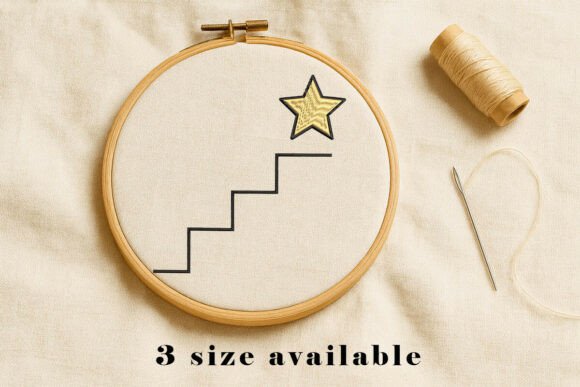
As an embroidery designer who’s prepped over 200 craft fair booths, I’ll say it straight: Stairway to Star Embroidery Design lands with calm authority—not loud, not cutesy, not rustic or retro. It’s modern minimalism with emotional resonance. That staircase leading upward to a golden star reads instantly as growth, aspiration, and gentle optimism—ideal for handmade product storytelling without needing words. It feels premium but approachable, making it perfect for House category items like tea towels and pillow covers where tone matters as much as texture.
Where It Shines in Real Craft Fair Displays
In my booth setup—tote bags stacked at the front, aprons draped over a ladder shelf, tea towels folded beside embroidered pouches—Stairway to Star Embroidery Design stands out strongest on three items: medium-sized tote bags, linen aprons, and square cotton tea towels. On a tote, centered just below the handle seam, it reads clearly from six feet away. On an apron’s chest pocket, it adds intention without overwhelming utility. And on a tea towel? It transforms a functional item into a giftable handmade product—elegant, symbolic, and quietly memorable.
It works well as a small focal point too: think embroidered patches (great for denim jackets or market bags), slim fabric pouches (perfect for gift sets), or cap fronts—but only if sized thoughtfully. On curved cap surfaces, the staircase must be scaled to avoid distortion; test that early. Pillow covers and small pouches benefit most when the design is used at 3.5–4.5 inches wide—large enough to read the structure, small enough to preserve negative space.
Online & Etsy Performance: Clean, Clickable, Consistent
This design photographs beautifully for digital listings. Its high-contrast potential (dark fabric + gold or metallic thread) creates strong visual pop in Etsy thumbnails and printable mockups. Because it’s uncluttered and symbol-driven, buyers instantly “get it”—no caption needed. That clarity boosts conversion for digital embroidery file sellers and small shop owners building cohesive design assets. As a machine embroidery design, it also supports brand consistency across product lines: same motif on your apron, your tea towel, and your patch pack tells a unified story about craftsmanship and intention.
That said—don’t assume it’s universally scalable. At under 2 inches wide, the star can blur or disappear on textured towels or thick canvas. Tiny details like stair risers or fine star points may collapse on dense fabrics unless stitch density is optimized. Always confirm spacing between elements holds up at your target size.
Production Reality Check: What You Must Test Before Booth Day
Before cutting fabric or loading hoops, treat Stairway to Star Embroidery Design like any commercial embroidery asset you’d sell yourself:
- Test on scrap fabric matching your final product—especially for tea towel embroidery (terry loops love to swallow fine stitches) and apron embroidery (linen shifts, cotton twill puckers).
- Check thread contrast: golden star = gorgeous on navy, charcoal, or cream—but disappears on yellow or light gold fabric. Dark thread on dark fabric needs metallic or high-sheen alternatives.
- Review spacing and stitch density: Is the gap between stairs consistent? Does the star have enough fill to shine without overloading the area?
- Confirm hoop size and stabilizer: Minimalist doesn’t mean low-stitch—it still needs appropriate cutaway or tear-away backing depending on fabric texture.
- Create one real mockup before batch production. A single embroidered tote bag tells you more than ten digital previews.
- Compare fabric colors side-by-side: Light gray linen vs. oatmeal cotton reads differently under fair lighting—and affects how “golden” that star appears.
- Verify commercial licensing before selling finished products. If this is a digital embroidery file you’re using, ensure your license covers resale of physical handmade products.
Selling Psychology: Why Customers Pause, Point, and Purchase
In a crowded craft fair aisle, Stairway to Star Embroidery Design triggers subtle emotional recognition—not “cute,” not “funny,” but meaningful. Buyers pause because it feels intentional. They point because it’s legible and balanced. They purchase because it elevates an everyday item into something aspirational yet grounded.
That symbolism translates directly to perceived value. A $28 embroidered tote bag with this design feels more considered—and justifies its price—versus generic florals or script quotes. For Etsy sellers, it supports higher AOV (average order value) when bundled: “Stairway to Star” tea towel + pouch + patch becomes a curated gift set. And for boutique makers, it strengthens booth display strength: grouped items with the same motif create rhythm and cohesion, drawing the eye deeper into your table.
Careful-Use Notes: Protect Clarity, Preserve Charm
Avoid placing Stairway to Star Embroidery Design on:
- Fabrics with heavy texture (like waffle-weave towels) unless enlarged to at least 4 inches and stitched with reduced density.
- Dark fabric without testing metallic or high-contrast thread—gold thread isn’t always visible on black denim or charcoal twill.
- Curved surfaces (caps, curved pouches) without adjusting placement and scale to prevent stair distortion.
- Small patches under 2 inches—risers and star points risk stitching into illegibility.
- Dense stitch zones near seams or hems where puckering could obscure the staircase’s clean line.
When executed well, this embroidery file doesn’t just decorate—it invites reflection. That’s rare in craft fair product development. It’s not flashy, but it’s unforgettable. And in a sea of handmade product noise, unforgettable is what sells.