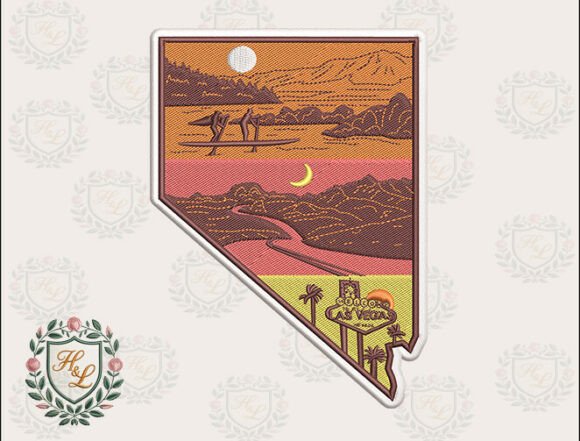
Layers of Nevada Embroidery Files
A Designer’s First Look: What This Appliqué Design *Feels* Like
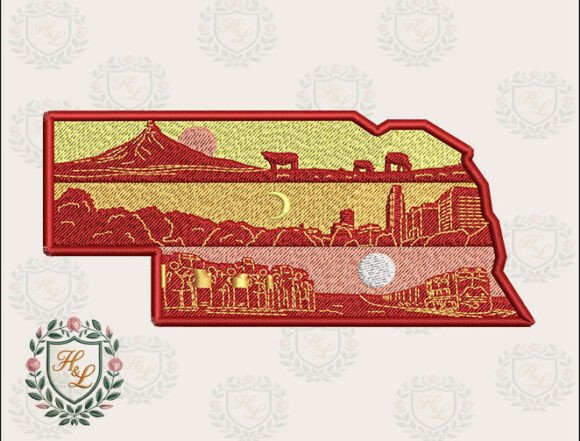
Opening Layers of Nevada Embroidery Files, I didn’t just see a map outline—I felt the quiet weight of high desert light. It’s not a literal cartographic rendering, but a layered, stylized interpretation: clean outer borders, subtle internal divisions suggesting mountain ranges and basins, and a gentle rhythm in the line work that reads as both grounded and expansive. As an embroidery designer who’s stitched hundreds of regional motifs, what stands out is how thoughtfully this appliqué design balances simplicity with character. It doesn’t shout. It invites—especially on natural fibers like cotton canvas, linen tea towels, or unbleached denim aprons.
Real-World Use: From Sketch to Stitched Tote Bag
Last week, I prepped a small-batch run of custom embroidered tote bags for a local boutique—think sturdy 12-oz canvas, natural dye finish, meant for farmers’ markets and indie bookshops. I chose Layers of Nevada Embroidery Files as the centerpiece for the front panel. Why? Because it scales beautifully without losing legibility at 4.5 inches wide, holds up under moderate stitch density, and carries enough visual presence to anchor a minimalist bag without overwhelming it. Customers responded immediately—not with “What state is that?” (though some asked, warmly), but with “That feels like home,” or “I love how calm it looks.” That emotional resonance matters more than geographic precision in handmade product design.
Where It Shines—and Where It Needs Thoughtful Handling
Layers of Nevada Embroidery Files performs exceptionally well on stable, medium-weight fabrics: sweatshirt fleece, twill patches, pillow covers, and structured kitchen towels. The satin stitch borders define shape cleanly, and the fill stitch areas are dense enough for coverage but not so heavy that they stiffen lightweight cotton. On baby items—like organic cotton burp cloths or muslin swaddle tags—it reads softly when stitched in tonal thread (e.g., heather gray on oatmeal fabric), making it gentle and gender-neutral.
But let’s be direct: avoid using it full-size on curved surfaces like caps without testing placement and digitization flow first. The lower-left corner has a subtle notch that can distort if hooped too tightly on a rounded crown. Also, on stretchy knits (think ribbed baby onesies or performance tees), stabilize generously—this isn’t a running-stitch sketch; it relies on clean satin edges, and stretching mid-stitch blurs those lines. And while it works on dark fabric, skip ultra-fine white thread for the outer border unless you’re using a high-contrast stabilizer underneath—the fill areas need breathing room to stay legible.
Commercial Realities: What This Design Does for Your Craft Business
If you’re an Etsy seller or small shop owner building a cohesive regional collection, Layers of Nevada Embroidery Files adds quiet authority. It doesn’t compete with loud typography or cartoonish icons—it complements them. Pair it with a simple serif monogram or a short handwritten phrase (“Born Here,” “High Desert Heart”) and you’ve got a gift-ready, shelf-differentiated product. Buyers trust subtlety when it’s executed well: it signals care, intention, and design literacy—not just another clipart download.
For personalized gifts—custom nursery decor, wedding guest favors, or anniversary pillows—this design lands with warmth and longevity. It doesn’t date quickly. Unlike trend-driven motifs, it reads as timeless because its strength is in proportion and restraint, not novelty. That directly supports perceived value: customers pay more for pieces that feel curated, not assembled.
Practical Designer Notes Before You Stitch
- Always test on scrap fabric first—especially if stitching on textured weaves (like burlap blends) or laminated cottons where thread tension shifts unpredictably.
- Check thread color contrast across your intended product line. A single navy thread may read perfectly on cream canvas but vanish on charcoal terry cloth.
- Review stitch density before scaling. If you plan to shrink Layers of Nevada Embroidery Files below 3.75 inches, inspect inner details in your embroidery software—some layered zones tighten and risk “stitch crowding” that flattens dimension.
- Confirm hoop size compatibility with your most-used machine. While it’s labeled as a digital appliqué design, the final stitched footprint determines whether it fits comfortably in a 5x7 hoop—or requires re-hooping on larger items like blanket corners.
- Inspect small details manually: the junction where the western border meets the central basin is a fine point—verify it stitches cleanly on your test run.
- Test black-and-white mockups before listing. This design relies on shape and spacing, not color, so grayscale previews should still communicate its balance and clarity.
- Compare light and dark fabric backgrounds side-by-side. Some satin stitch reflections behave differently on matte vs. semi-gloss finishes.
- Use appropriate stabilizer: tear-away for stable wovens, cut-away for knits or anything that will be washed repeatedly.
- Verify licensing terms before selling finished products or bundling Layers of Nevada Embroidery Files into digital embroidery kits—commercial use rights aren’t automatic, even with “high-quality digital appliqué design” in the description.
Final Thought: Not Just a Map—A Design Decision
Layers of Nevada Embroidery Files isn’t about checking a geography box. It’s about choosing a motif that supports your brand voice—whether that’s earthy and unhurried (for a sustainable apparel line), quietly proud (for a regional gift shop), or thoughtfully personal (for heirloom baby embroidery). In a market flooded with over-digitized, oversaturated designs, its restraint is its strength. Used with attention to fabric, scale, and context, it becomes more than decoration. It becomes part of the story your handmade product tells—before a single word is read, before a single stitch is sold.