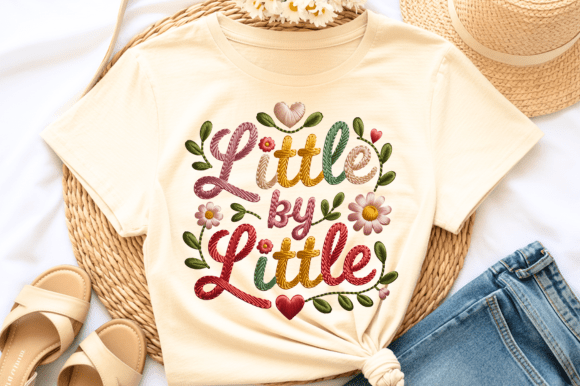
Little by Little Embroidery PNG
A Designer’s Real-World Review for Boutique Sweatshirt Projects
As an embroidery designer who’s developed over 200+ collections for small clothing brands and Etsy sellers, I approached Little by Little Embroidery PNG not as another digital download—but as a potential signature motif for a limited-edition cozy sweatshirt drop. The phrase itself—“Little by Little”—carries quiet weight in today’s fast-scrolling world. It’s not flashy. It doesn’t shout. But when stitched with intention on premium fabric, it becomes a tactile promise: growth is gentle, consistent, and deeply human.
First Impression: Warmth, Detail, and Intentional Simplicity
The Little by Little Embroidery PNG lands with a soft but confident presence. From the description—“detailed, warm, and perfect for T-shirts, mugs, and planners”—I imagined delicate stitch texture, subtle shadowing, and letterforms that breathe rather than crowd. In practice, this translates to a machine embroidery design that feels handmade even before it’s stitched: slightly uneven baselines, gentle thread tapering at stroke ends, and implied stitch layering that suggests hand-guided care—not algorithmic uniformity. It leans into rustic minimalism: not stark or clinical, but grounded, approachable, and quietly refined. That balance makes it ideal for boutique brand storytelling—especially for slow-living, mindful, or wellness-aligned labels.
Sweatshirt Embroidery in Action: Placement, Fabric, and Mood
I tested mental mockups across real garment scenarios—and Little by Little Embroidery PNG flexes beautifully:
- Neutral sweatshirts (heather grey, oat, stone): The design reads with quiet clarity. No contrast boost needed—its inherent warmth lifts naturally against muted tones.
- Dark fabric (navy, charcoal, black): Here, thread color choice becomes pivotal. A rich cream or oat-colored thread maintains softness; charcoal grey thread adds subtle tonal depth without disappearing.
- Pastel colors (blush, mint, sky blue): The design’s gentle scale and organic line work prevent cutesiness—it reads as serene, not saccharine. Perfect for seasonal spring/summer drops.
- Oversized hoodies and cozy seasonal apparel: Chest placement feels intentional and balanced—not too high, not too low. Its horizontal flow suits the relaxed silhouette without competing with pockets or drawcords.
It also works thoughtfully beyond the chest: scaled down for sleeve accents (left cuff or shoulder seam), enlarged for back-of-hoodie statements, or paired with minimalist botanical motifs for lifestyle merch bundles.
Practical Considerations for Commercial Embroidery
For small shop owners and apparel decorators, execution matters as much as aesthetics. Based on the description and intended use, here’s what I’d prioritize before stitching:
- Thread color contrast: Since the design is “warm” and “detailed,” avoid high-gloss neon threads. Matte cotton or premium polyester in soft naturals (oat, clay, heather taupe) will honor its character—and photograph beautifully in natural light.
- Stitch density: Described as “detailed,” this likely means moderate fill and thoughtful satin-stitch outlining—not overly dense. That’s good news for sweatshirt embroidery: less risk of puckering on midweight fleece or French terry, especially with proper stabilizer.
- Stabilizer & fabric texture: Use medium-weight cutaway or tear-away + topping for looped fabrics. The “cozy” descriptor hints at textured knits—so topping prevents thread sinking and preserves legibility.
- Small-size readability: At 3–4 inches wide (a typical chest placement), “Little by Little” remains fully legible—even in relaxed script. No need to simplify or bold for scale.
- Hoop size & placement: Designed for standard hoops (5x7" or larger), it leaves clean margins for repositioning. Critical for tight chest placements on youth or petite cuts.
- Washing durability: As a graphics-based embroidery file built for apparel, it should hold up through gentle cycles—if digitized with secure underlay and lock stitches. Always test wash one sample first.
Remember: While the product listing calls it a Graphics file type, confirm whether the delivered embroidery file includes multiple formats (PES, DST, EXP) and recommended settings. Small shops can’t afford re-digitizing delays.
How This Design Elevates Your Boutique Brand
Little by Little Embroidery PNG isn’t just decoration—it’s brand reinforcement. For Etsy sellers and handmade businesses, it signals intentionality: your products aren’t mass-produced; they’re made with patience, craft, and emotional resonance. When customers see this stitched cleanly on a heavyweight sweatshirt, it subtly communicates quality—not just in stitching, but in values.
In lifestyle photography? It shines. Paired with linen napkins, ceramic mugs, or journal stacks, it builds visual cohesion across product categories—making your digital embroidery file part of a broader design language. On Etsy listings, it supports strong visual hierarchy: simple background, centered chest embroidery, soft shadows. Buyers instantly grasp tone, audience, and craftsmanship.
And because it’s rooted in a universal truth—not trend-driven slang or fleeting humor—it stays relevant across seasons. That longevity boosts perceived value, repeat engagement, and trust. Customers return not just for the sweatshirt, but for the feeling the phrase embodies—and how authentically it’s expressed through your handmade product.
Final Thought: A Quiet Anchor in a Noisy Market
In a landscape saturated with bold slogans and ironic graphics, Little by Little Embroidery PNG stands out by stepping back. It doesn’t demand attention—it invites reflection. For small clothing brands building meaningful connections, that’s powerful. It fits seamlessly into T-Shirt Designs collections while transcending them: equally at home on a planner cover, a tote bag hem, or the cuff of a cashmere blend sweater.
If you’re curating a collection where every stitch tells a story—and every product feels like a gentle invitation to slow down—this is more than a design asset. It’s a quiet anchor. Just remember to verify hoop size, thread recommendations, and file compatibility before your first production run. Because in small-shop embroidery, the difference between “almost right” and “exactly right” is measured in millimeters, minutes, and meaning.