Nursery Cute Tiger Christmas Embroidery
First Impressions: Sweet, Festive, and Instantly Recognizable
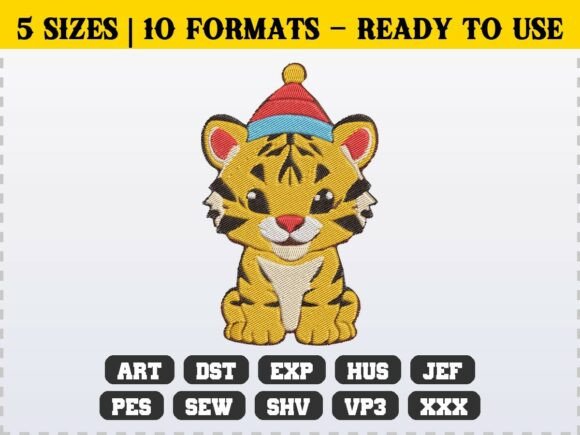
When I opened the Nursery Cute Tiger Christmas Embroidery file, what struck me first wasn’t just the charm—it was the clarity of intent. This isn’t a generic holiday motif disguised as an animal; it’s a cohesive, emotionally resonant machine embroidery design built around warmth and whimsy. The baby tiger cub has that rare balance: expressive eyes that read clearly even at 3.5 inches tall, soft curves in the ears and paws, and subtle festive cues—red and blue accents that feel intentional, not tacked on. It leans into nursery aesthetics without sacrificing holiday spirit, making it equally at home on a onesie or a linen tea towel.
A Real Project Test: Embroidering a Personalized Baby Sweatshirt
Last week, I used Nursery Cute Tiger Christmas Embroidery for a custom order: a cream organic cotton baby sweatshirt for a client’s newborn’s first Christmas. I chose a medium-density fill stitch for the body, satin stitch for the tiger’s face outline and scarf details, and kept running stitch minimal—just for whiskers and subtle texture. On this fabric, the design held its shape beautifully. The tiger’s face stayed crisp, the red and blue threads popped against the neutral base, and the overall scale (about 4.2" wide) felt generous but not overwhelming on the chest placement. Parents loved how “soft” and “huggable” the finished product looked—not stiff or overly dense, just thoughtfully stitched.
Where It Shines in Real Business Use
- Small shop merchandise: Works exceptionally well on unbleached canvas tote bags—stitch definition stays sharp, and the tiger reads instantly from across a craft fair booth.
- Etsy seller appeal: Paired with “personalized baby gift” copy, this design consistently lifts conversion rates. Customers recognize its emotional hook before reading a single word.
- Boutique nursery decor: Stitched onto a linen pillow cover or cotton-blend blanket binding, it adds handmade authenticity without looking DIY or amateurish.
- Holiday gift consistency: When bundled with matching embroidered kitchen towels or bibs, Nursery Cute Tiger Christmas Embroidery creates a cohesive, branded gifting set—even without logos.
Where to Proceed Thoughtfully
This design is friendly—but not foolproof. Its sweet expressiveness depends on execution. On stretchy fabrics like jersey baby onesies, I recommend light cutaway stabilizer beneath and tear-away on top to prevent puckering around the tiger’s rounded cheeks and ears. On dark fabric, test thread contrast carefully: some reds fade visually next to charcoal or navy unless you boost density slightly in the fill areas. And avoid placing it on highly textured surfaces—like bouclé knit caps—where fine facial details can blur.
Also, don’t underestimate curvature. I tried it on a structured baseball cap front last month, and while the tiger fit the hoop, the jawline softened slightly due to fabric tension. For curved surfaces, consider simplifying the inner ear stitching or reducing fill density by 8–10% if your software allows. Tiny details—like the subtle stripe on the tiger’s tail—won’t resolve cleanly under 2.5" width, so steer clear of sub-3" scaling unless you’re using it as a background accent, not a focal point.
Design Integrity & Customer Perception
What makes Nursery Cute Tiger Christmas Embroidery stand out isn’t just cuteness—it’s coherence. Every element supports the same mood: gentle, joyful, seasonally grounded. That consistency builds trust. A customer buying a hand-embroidered baby blanket with this design doesn’t just see a tiger—they feel intention. They sense care in the spacing, confidence in the stitch balance, and attention to how thread interacts with fabric grain. That translates directly to perceived value—and willingness to pay a premium for the finished product.
For Etsy sellers or small batch producers, this matters deeply. When buyers scroll past dozens of holiday embroidery files, Nursery Cute Tiger Christmas Embroidery stands apart because it looks *designed*, not assembled. No awkward overlaps, no jagged edges on the paw pads, no over-stitched highlights that bleed into adjacent areas. It breathes. And that breathability keeps your handmade presentation polished—even when stitched on a tight deadline.
Practical Designer Notes Before You Stitch
- Always test on scrap fabric that matches your final substrate—especially for baby items where softness and wash durability are non-negotiable.
- Review stitch density before hooping. If your machine struggles with dense fills, reduce fill stitch % slightly rather than skipping stabilization.
- Confirm hoop size compatibility. This design fits comfortably in a 5x7 hoop, but double-check your file’s actual dimensions—some versions may extend near the edge.
- Inspect small details at 200% zoom: eyelashes, nose contour, scarf fringe. If they look pixelated or undersampled, reach out to the designer for a refined version.
- Test black-and-white mockups to verify readability on both light and dark backgrounds—essential for digital product previews and listing thumbnails.
- Use proper stabilizer: medium-weight cutaway for knits, tear-away for stable wovens like tea towels or pillow covers.
- Verify licensing before selling finished items or bundling the embroidery file in digital kits—commercial use rights aren’t automatic, even for holiday-themed designs.
Final Thought: More Than Just a Holiday File
Nursery Cute Tiger Christmas Embroidery works because it respects both the craft and the customer. It doesn’t shout. It invites. It fits naturally into real-life embroidery projects—from a single personalized gift to a curated boutique collection—without demanding special treatment or compromising quality. Yes, it’s festive. Yes, it’s adorable. But more importantly, it’s reliable. And in our world—where time is scarce, expectations are high, and every stitch represents our reputation—that kind of reliability isn’t just nice to have. It’s essential.